C. Dana Bush, reprint of Alberta Wilderness Association 2025 Bioblitz Report
September 2026
Cypress Hills Interprovincial Park is a hot spot for hawthorns (Crataegus). According to Phipps and O’Kennon (2007) and Kershaw and Allen (2024, 2025), there are eleven species of hawthorns in Alberta, nine of which are rare, and all of which occur in the Cypress Hills, Alberta side.
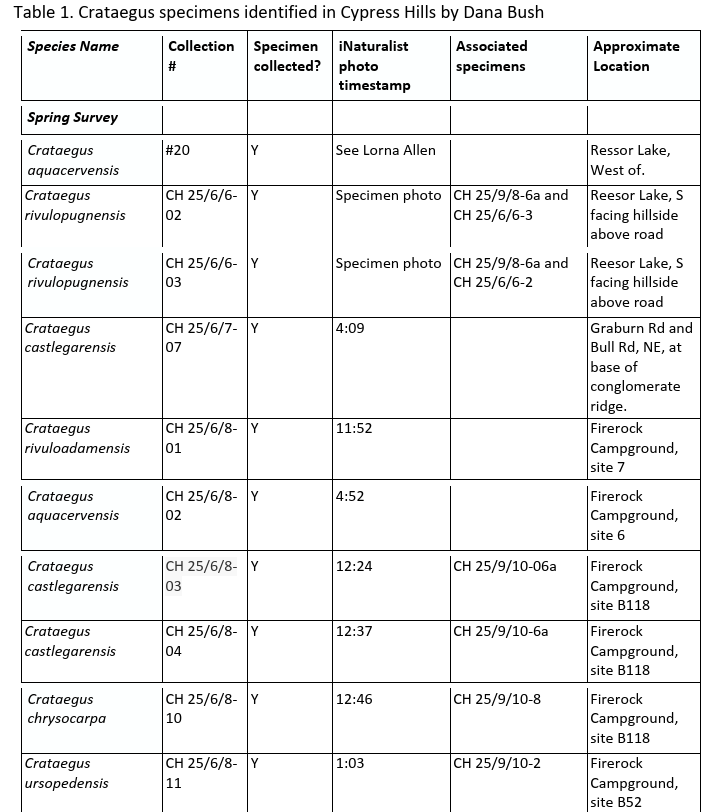
During the 2025 Cypress Hills Bioblitz, running June 6-8, Dana Bush and Lysandra Pyle spent an afternoon collecting specimens from known locations in the Firerock Campground west of the Elkwater townsite. It soon became clear that identifying hawthorns from flowering specimens was extremely difficult (Phipps FNA), so Dana Bush made another collecting trip on September 8-10, 2025, to re-collect from the spring specimens, and collect more specimens from different locations.
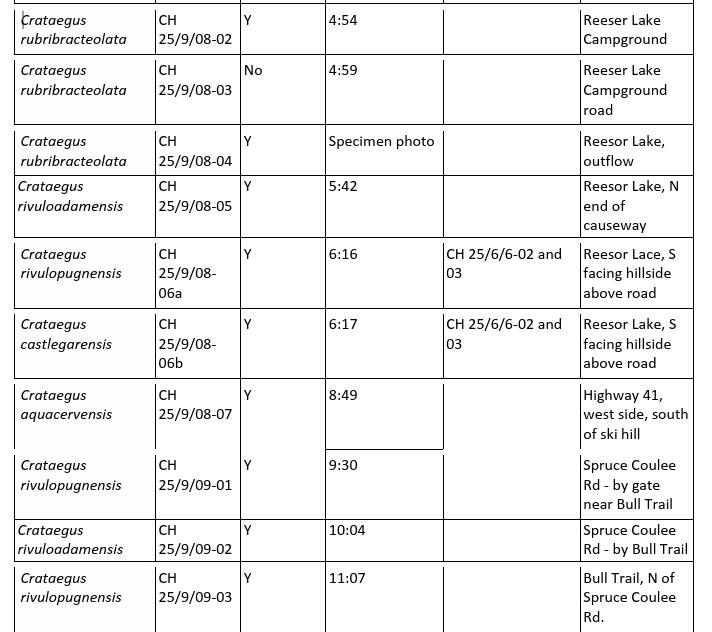
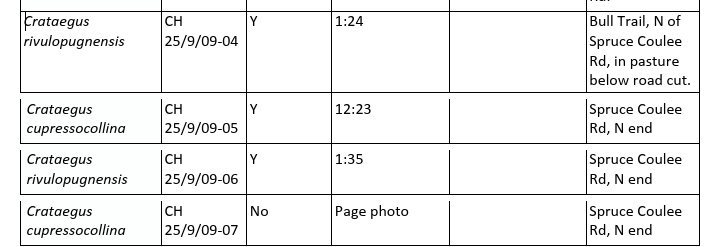
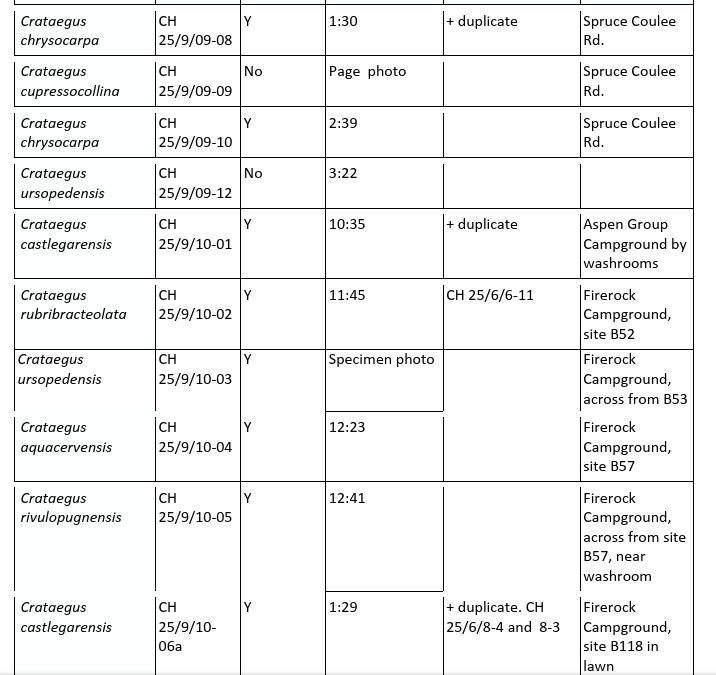
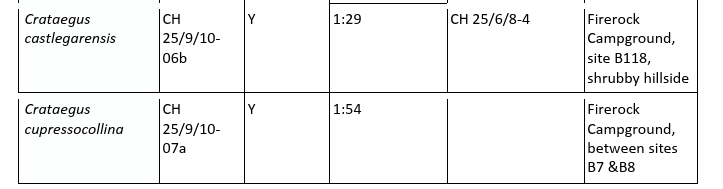
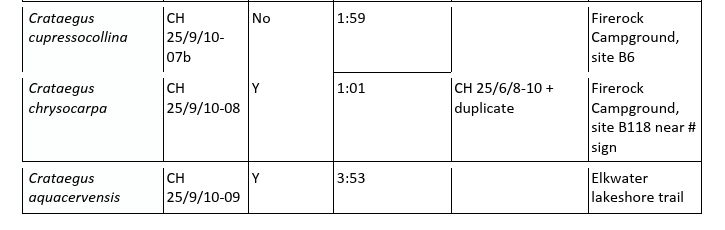
Numerous specimens were collected from the Reesor Lake Area; the Firerock Campground; along Spruce Coulee Road and Bull Trail; and incidental specimens from other areas (see Table 1). A total of eight hawthorn species were documented in 40 sites, with 38 specimens collected.
iNaturalist (2026) shows 56 observations and 8 species during the June 6-9 timeframe, but many of these are listed as Genus Crataegus and few entries indicate that specimens were collected. Research grade identification of these entries are doubtful.
Identification, even with thorns and fruits, and in some cases flowers, was problematic. There is a great deal of overlap in fruit colour, thorn length and shape, leaf sizes, and nutlet shape. The author could not find a local botanist who was willing to identify the specimens, with many expressing doubts about the usefulness of the key, and the number of identifiable species in Alberta, and Montana. “Many of the taxa proposed by Phipps and O’Kennon (1997) may be good species, but I am unable to distinguish them in our collection. My treatment is conservative pending more investigations into the group. Mature fruit may be required for determination” (Lesica 2012).
Specimens were identified using Phipps and O’Kennon (1997), Kershaw and Allen (2024, 2025), the Rare Vascular Plants of Alberta, 2nd. Edition (2022), and Phipps (vol 9 FNA), and by comparing to a small collection of specimens identified by Phipps, held at the University of Calgary Herbarium. Names have been applied to all specimens, however I have only moderate confidence in the identifications. Étienne Léveillé-Bourret, professor of plant systematics and evolution at Université de Montréal, and curator of the Marie-Victorin Herbarium (MT), with an expertise with Crataegus, has graciously agreed to examine the specimens and verify or correct the identifications. This report will be updated once this is complete.
Once identifications are completed, specimens will be submitted to herbaria at the University of Calgary, University of Alberta, University of Lethbridge, ABMI and Medicine Hat College.
On the final day of the event, ANPC participated in outreach by setting up a booth at the Education Center in Cypress Hills, and leading guided hikes to identify plants.
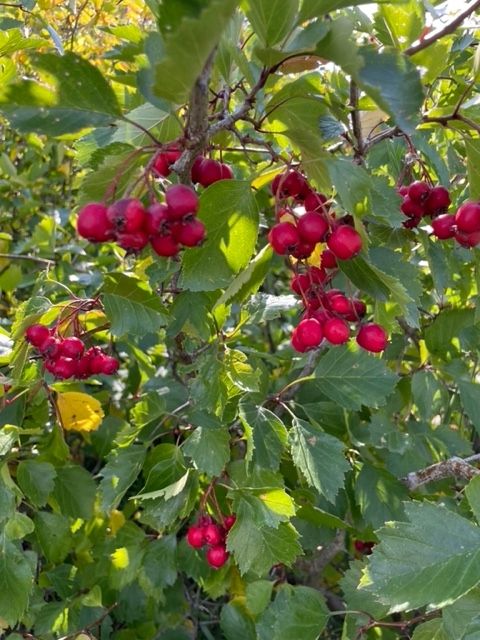
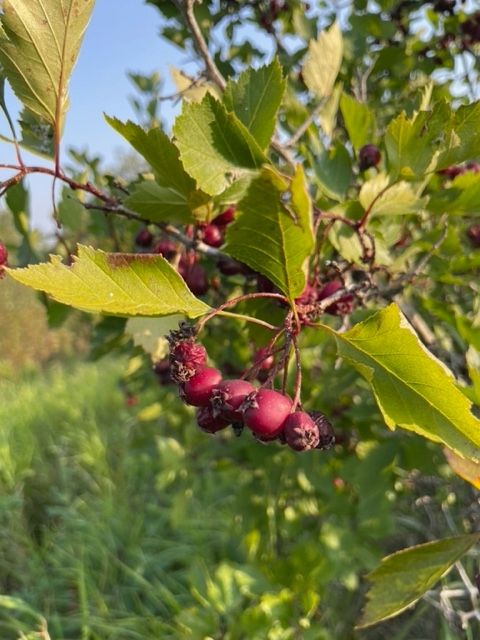
Recommendations for future collections:
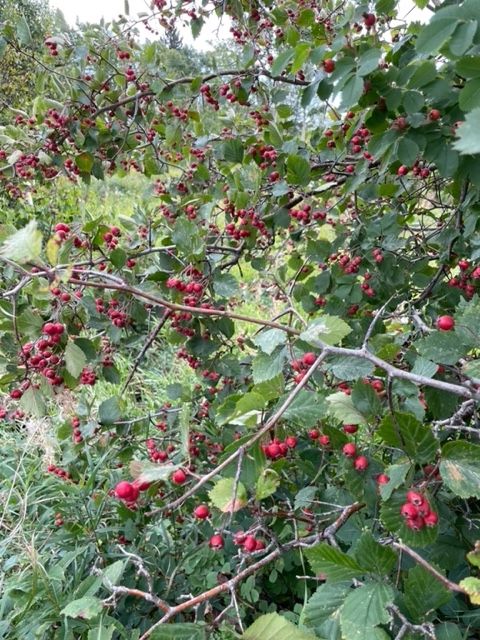
Identifying hawthorns is not easy for amateur or even skilled botanists. A systematic collection with samples taken in spring and fall, from the same plants, with descriptions and photographs, would be useful. Multiple species occurring together made the task of matching spring and fall plants difficult. In future, metal tags with collection numbers should be attached, so that spring and fall collections can be matched correctly.
Descriptions and photos of the overall form of the plant (height, branchiness, numbers and position of fruit clusters, etc.) should be collected, as these characteristics may be more descriptive of the species, even though they are relatively subjective and are not included in the key (Phipps and O-Kennon 1997 and Étienne Léveillé-Bourret).
Timing is important, as some species flower earlier than others, and as fruits mature they change colour, so extensive collecting during a short window is more preferable than occasional collecting over a month (Phipps FNA). The colour of the fresh fruits should be noted, as colour changes as the fruits dry.
DNA analysis might clarify the species identifications.