Natalia Gala
November 2026
Work together. Share. Be grateful for what you have. These are all lessons we grow up hearing, yet they can often seem at odds with the way our world is structured. Every student of economics learns early on that the biggest challenge of our society is scarcity, and every ambitious company strives to outcompete its rivals. To get what you want, you must fight with teeth and nails—or do you? What if the water and land isn’t scarce, and there is enough to go around for everyone? What if the key to prosperity isn’t accumulating, but sharing?
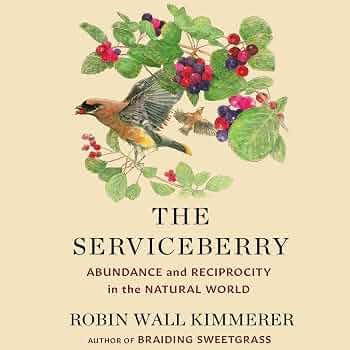
Robin Wall Kimmerer’s newest book, The Serviceberry: Abundance and Reciprocity in the Natural World, explores these questions with a backdrop of juicy, sweet metaphors and botanical tidbits. Kimmerer, an Indigenous botanist, educator, and author, recounts her own poignant—and often, delicious—experiences to create a narrative that is as immersive as it is educational.
Kimmerer advocates for the adoption of a “gift economy”. The gift economy is a system based on Indigenous worldviews, and the idea that gratefulness has the power to profoundly change our perspectives and values. But rather than relying solely on ethics and ideals, Kimmerer leans on her trade: botany. She casts nature as a teacher, and uses science and economics to show us precisely why we have so much to be grateful for.
So, what exactly is a gift? You’ll probably agree that a gift is something you don’t need to pay for or earn, yet enriches your life for “free”. But, if that’s how we define a gift, then aren’t all the berries sprouting from wild bushes gifts? Isn’t the rain, falling from the sky uninvited, also a gift?
Kimmerer explains how viewing the land and all its resources as gifts is a key part of Indigenous worldviews. In fact, these resources tend not to be called “resources” at all. Everything in nature is part of a cycle full of gift-giving, gift-accepting, and recycling. There is enough to go around for everyone, because there needs to be—plants and animals are interconnected, and so are humans. A flower won’t survive without its pollinators; pollinators won’t survive without their flowers. Ever the botanist, Kimmerer takes us on a journey to explore ecological balance.
The Serviceberry dives deep into the phenomenon of reciprocity in nature. Kimmerer describes the way plants and animals are related, then links it to reciprocity in human society—when you give a gift, chances are that the person who receives it will be grateful, and will treat your gift with more respect than if it was just a “commodity”, an object without emotional baggage. It is also likely that the receiver will give something in return—that “something” might just be gratefulness, or it might be the formation of a lifelong relationship of mutual sharing and joy that benefits everyone.
Kimmerer tells personal stories from her own community as examples of this deep relationship-building. Her descriptions of her neighbours are as heartwarming as they are immersive, as the book gains characters and personalities despite being non-fictional. She often alludes to “having enough”—a belief that may help stave off environmental crises, by discouraging endless consumerism—and using leftovers to ensure there is “abundance” for everyone.
Kimmerer refers to economists ranging from Adam Smith to Elinor Ostrom to contrast different economic models. Touching onto ideas such as the “Rational Economic Man”, which assumes inherent human greed, as well as modern market theory, she lays out her reasons for opposing a philosophy of scarcity. She admits that she is not an economist, and is grateful for her economist friends. This in itself is an ironic example of the gift economy in action.
Indigenous treaties and myths further enrich the book’s narrative. Kimmerer delves into the Potawatomi language to emphasize the importance of serviceberries—“Bozakmin”—in her culture, and discusses historic treaties and customs. The cultural value of The Serviceberry is evident throughout the book, yet it doesn’t bias or overshadow Kimmerer’s broader arguments.
Kimmerer also introduces readers to the relatively new field of biomimicry, and muses on how the gift economy can be applied to modern settings beyond small communities. She tackles heavy issues such as colonialism and the Tragedy of the Commons, yet somehow maintains her optimism throughout. The book is endlessly rich with symbolism. If you’re curious to know what a cannibalistic, mythical beast called Windigo has to do with gratitude, you’ll just have to read it yourself!
Kimmerer’s writing is never preachy nor overly academic. Her examples are relatable and human, making it feel as though she is merely having a conversation with the reader rather than writing a complicated essay. There is something very friendly and inviting in the way she interjects her philosophical musings with descriptions of berry baskets and personal anecdotes.
Yes—the reader will leave with plenty of new ideas and thinking prompts. But it is not overly challenging to grasp Kimmerer’s arguments, and the book is a relatively quick read. Whatever fancy words Kimmerer uses only serve to enhance the beauty of her symbolism. At one point, she describes how her mitochondria dance when she eats berries—an unusual description, but typical for Kimmerer. Her words are as delicious as the berries. At times, they are almost poetic.
Anyone interested in learning more about Indigenous perspectives on the land will enjoy The Serviceberry, as will people who enjoy economic or environmentalist thought experiments. Fans of Kimmerer’s previous bestseller, Braiding Sweetgrass, will appreciate the similar style and philosophy.
The Serviceberry is definitely not a thriller, and there is a certain degree of repetition. If you’re looking to relax with a book that you can put down without losing your trail of thought, this is for you; if you prefer urgent, action-packed narratives over succulent, honest reflections, then it probably isn’t.
Overall, The Serviceberry hovers somewhere in the realm between a personal essay, a call to action, and a self-help book. That might seem like an odd combination, but Kimmerer succeeds in doing a rare feat: she warns us about the dangers of thoughtless greed, while providing an alternative system that can be adopted on both the individual and collective level. “The Guidelines of the Honourable Harvest”, a series of traditional rules to steer clear of overconsumption and environmental disrespect, can be followed by a single person as much as they can be followed by a community—after all, the gift economy often thrives best in tight-knit settings.
At the end of the day, The Serviceberry is feel-good and tender. Despite Kimmerer’s criticisms of capitalism and corporate greed, it never feels like this criticism takes center stage. She offers solutions more than complaints. This book will make you feel like Kimmerer is chatting with you about life in a vibrant garden.
Readers will feel hopeful and refreshed, but be warned that the book comes with a serious side-effect: an irresistible craving for fresh Bozakmin pie!