
This article summarizes the work of University of Alberta Environmental Law student Luke Aronyk, who completed a joint project with ANPC to analyze how Alberta’s regulatory framework accounts for ecosystem carbon in prioritizing lands for conservation and reviewing environmental impact assessments.
July 2026
Overview of the Issue: Very little legislation in Canada or Alberta explicitly addresses ecosystem carbon. This appears to be counter-productive to Canada’s aims to become net-zero by 2050 pursuant to their Paris Agreement obligations and enactment of the Canadian Net-Zero Emissions Accountability Act
To achieve net-zero all provinces need to work together to reduce emissions and conserve ecosystem carbon sinks (land that naturally absorb carbon from the atmosphere, such as wetlands, forests and grasslands). Peatlands are of particular interest due to their vast carbon reserves (estimated at 19 billion tonnes of carbon in Alberta’s peatlands alone).
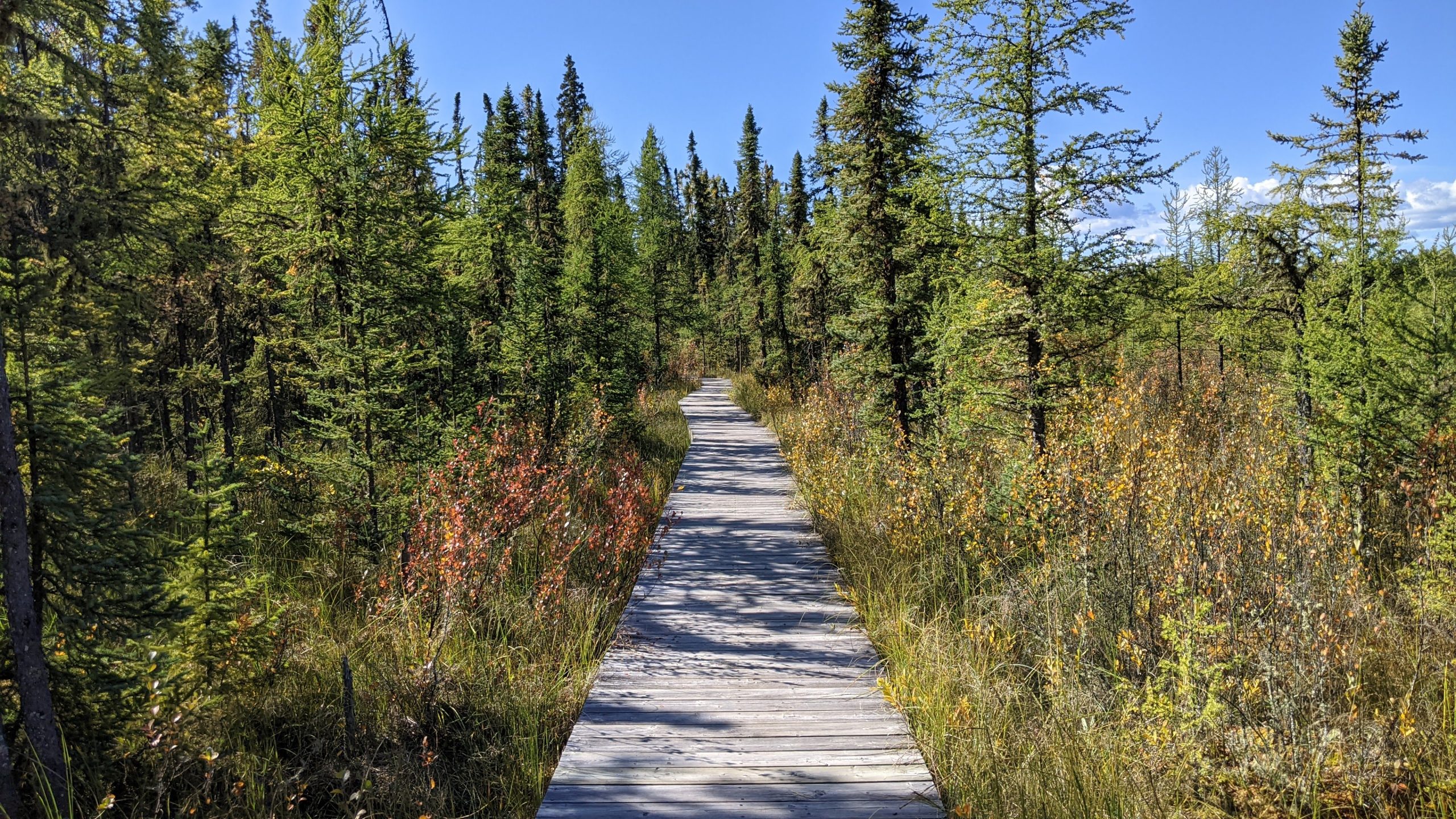
A carbon-rich fen located in Crimson Lake Provincial Park.
The International Court of Justice (ICJ) put out an advisory opinion in 2025 that put out following relevant findings:
- Canada, and potentially Alberta, have climate change obligations under treaties signed and international law.
- The United Nations Framework Convention on Climate Change (UNFCCC) of 1992 is still a binding instrument of international law that has powerful provisions Canada is still under obligation to follow.
- Article 4 of the UNFCCC obliges Canada to keep up-to-date national inventories of anthropogenic greenhouse gas emissions and removals of emissions by ecosystem carbon sinks.
Canada has not followed through on its UNFCCC obligations, and even though international treaties only bind our federal government, there is nothing lawfully preventing them from gathering the relevant information from every province to compile these inventories. In October of 2025, Danielle Smith signed a letter to the Minister of Environment and Protected Areas mandating them, among other things, to complete a report on Alberta’s carbon sink capacity to get a better understanding of Alberta’s position in relation to carbon neutrality. Additionally, the government of Alberta has made recent revisions to the provincial Wetland Policy, however it is notably missing content on accounting for carbon sinks. These documents look promising, but there is a lot left to be desired.
Relevant Legislation: There is various legislation that regulates development on land in Alberta, with some of the most important being: the Environmental Protection and Enhancement Act (EPEA), the Alberta Land Stewardship Act (ALSA), The Water Act and the Mines and Minerals Act (MMA). First off, none of these statutes mention carbon sinks specifically. Some of them do require science-based advisors and decision-making. These advisors might be best positioned to provide a framework for ecosystem carbon accounting in environmental impact assessments. When developments are approved, they must be announced publicly to allow for a certain level of public participation. Perhaps the best approach to mandating carbon accounting is through citizen action; however, if a citizen wants to challenge an approval they will need to prove they are “directly affected” by the project. However, if a municipality or Indigenous community neighbours a problematic development, they would likely be granted standing and could challenge a development. Hence making communities aware of what options they have when facing such developments could be an important step in furthering joint conservation and climate goals.
It would be ideal if the power to approve developments was consolidated into one body to avoid conflicts and disorganization. The federal Impact Assessment Act (IAA) attempts to consolidate efforts for projects which trigger a federal assessment. However, the IAA has been challenged by Alberta as federal overreach. Additionally the Building Canada Act (BCA) was recently enacted as a way to streamline projects deemed to be of national interest (i.e., pipelines) and purports to bypass IAA considerations. This suggests that Canada is moving towards rapid development rather than towards a more measured and climate conscious approach.
Other Jurisdictions: From the above it appears that Alberta has very little policy that directly addresses ecosystem carbon sinks. We might take lessons from Manitoba, who have the Peatlands Stewardship Act which prohibits anyone from developing on crown peatland without a peat exploration permit. It also creates a pathway for peatland conservation through the designation of Provincially Significant Peatlands. These sites are designated in recognition of both their biodiversity and enormous carbon stores.
The EU has a very comprehensive carbon sink preservation tool in its Land Use Change and Forestry Regulation (LULUCF) that sets legally binding net carbon removal targets for member states’ land sectors by 2030. It focuses primarily on forestry but can be applied to peatlands as well. It has enforcement provisions that oblige members to submit annual reports and punishes members if they do not meet their goals.
Indonesia has their Forestry and Other Land Use (FOLU) Plan which specifically addresses peatlands and their carbon sink potential. This plan seeks to restore millions of hectares of peatland by 2030 with mitigating climate change as its primary motivation. FOLU’s policies would be ideal to model in jurisdictions seeking net-zero commitments by addressing both emissions and sinks, something not even the LULUCF has achieved.
Finally, New Zealand has a “market model” by way of an emission trading scheme. Forest owners generate “New Zealand Units” that corporations can buy to offset their carbon emissions. A similar program exists in BC where Indigenous owners of the Great Bear Rainforest are able to sell carbon offsets to companies, however this is not a government initiative.
Recommendations: All of the effective policies listed above require accurate reporting of carbon sinks and emissions, so the first step would be to hold premiere Smith to her word and get an accurate carbon sink inventory. Reaching out to rural municipalities and Indigenous communities adjacent to key peatland areas could be an effective pre-emptive way to use our existing legislation to slow down problematic developments, including new open pit mine proposals in the oil sands region of Alberta. Market-centric policy would likely be well received in Alberta. If we could assign monetary value to ecosystem carbon, it could be possible to have policy that requires decisionmakers to take that value into consideration when approving projects and passing that cost onto developers.