
By Ashley Hillman, Central Alberta Plant Study Group Facilitator
April 2026
In summer of 2025, I was looking for somewhere near to my home in Edmonton where I could do some exploring and botanizing. I’ve explored Clyde Fen quite a bit, located approximately 90 km north of Edmonton, and was hoping to find other peatlands within a short drive of the city. After a scroll on Google maps, I noticed a very large peatland complex just east of Edson, near Sang Lake. It appeared to be a patterned fen, which was very exciting! After taking a quick check on iNaturalist to see what might be there, I discovered that it had zero recorded observations and I knew I had to check it out! So in July, a group of us headed to Edson to see what this fen might have to offer.
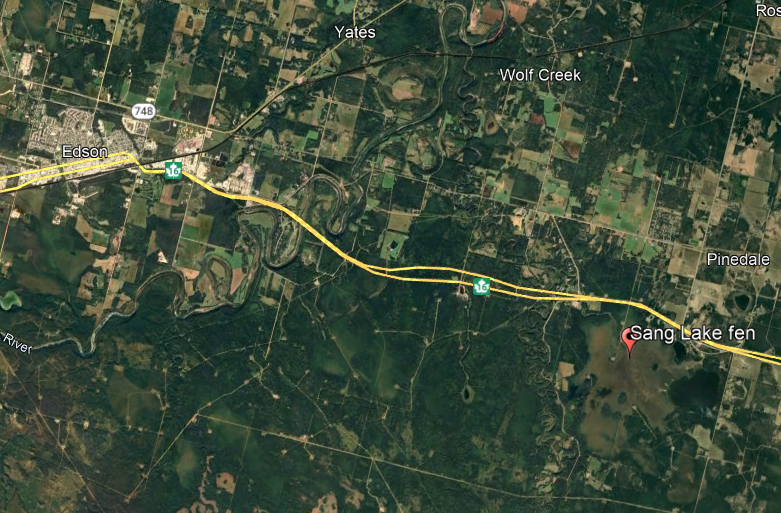
Location of Sang Lake Fen east of Edson.
Patterned fens are peatlands characterized by a series of ridges (strings) and saturated hollows (flarks). These strings and flarks are typically located perpendicular to the flow of water, and arise as a result of different rates of peat accumulation. These wave-like patterns of strings and flarks may not be very obvious from the ground, but can easily be seen from above. Plant communities between them differ slightly, with saturated flarks more likely to contain sedges and rushes, while the slightly drier strings may have sedges, herbs, low shrubs, and perhaps even short trees.
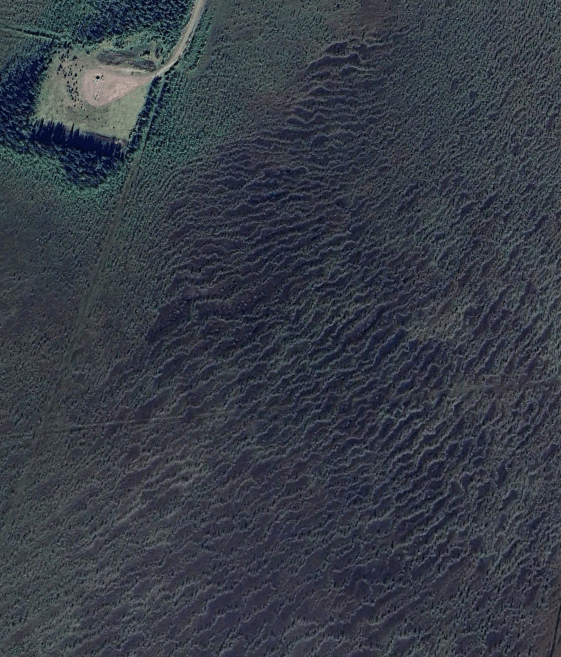

Patterning (strings and flarks) within Sang Lake Fen.
Upon arrival at the fen, we made it only about 5 m and were already enthralled by some amazing plants. We were immediately greeted by the vibrant white (and spicy scented!) flowers of tall white bog orchid (Platanthera dilatata). We also saw many other more common species throughout the fen, such as bogbean (Menyanthes trifoliata), grass-of-parnassus (Parnassia palustris), hooded ladies-tresses (Spiranthes romanzoffiana), sticky false asphodel (Triantha glutinosa), and several sedge species (Carex chordorrhiza, Carex interior, Carex limosa, and Carex diandra). We also found less common plants, such as rannoch-rush (Scheuchzeria palustris), small-flower lousewort (Pedicularis parviflora), and were thrilled to come across two observations of fen orchid (Liparis loeselii), which is listed as imperiled (S2) in Alberta.


Platanthera dilata (left), Spiranthes romanzoffiana (middle) and Scheuchzeria palustris (right).
We also thought that insects didn’t stand a chance in this fen, as there were some of the most abundant populations of carnivorous plants I’ve seen! Carnivory is a common adaptation plants have to living in low-nutrient habitats, such as peatlands. Modified leaves can help plants capture small insects, which can be digested to obtain additional nutrients not found in the water-logged soils of peatlands. In this fen, the relatively drier strings had small populations of round-leaved sundew (Drosera rotundifolia), a small carnivorous plant whose modified leaves produce a sticky substance that ensnares unsuspecting insects coming in to drink the “dew”. The wetter flarks boasted very healthy populations of Alberta’s other sundew species, both oblong-leaved sundew (Drosera anglica) and linear-leaved sundew (Drosera linearis). Within the most saturated flarks, we found three species of bladderwort (lesser bladderwort (Utricularia minor), intermediate bladderwort (Utricularia intermedia, and common bladderwort (Utricularia macrorhiza)), an aquatic carnivorous plant that uses submerged, air-filled bladders to suck in small prey swimming past. But it didn’t take us long to find our most exciting species: purple pitcher plant!


Drosera anglica (left) and Drosera linearis (right).
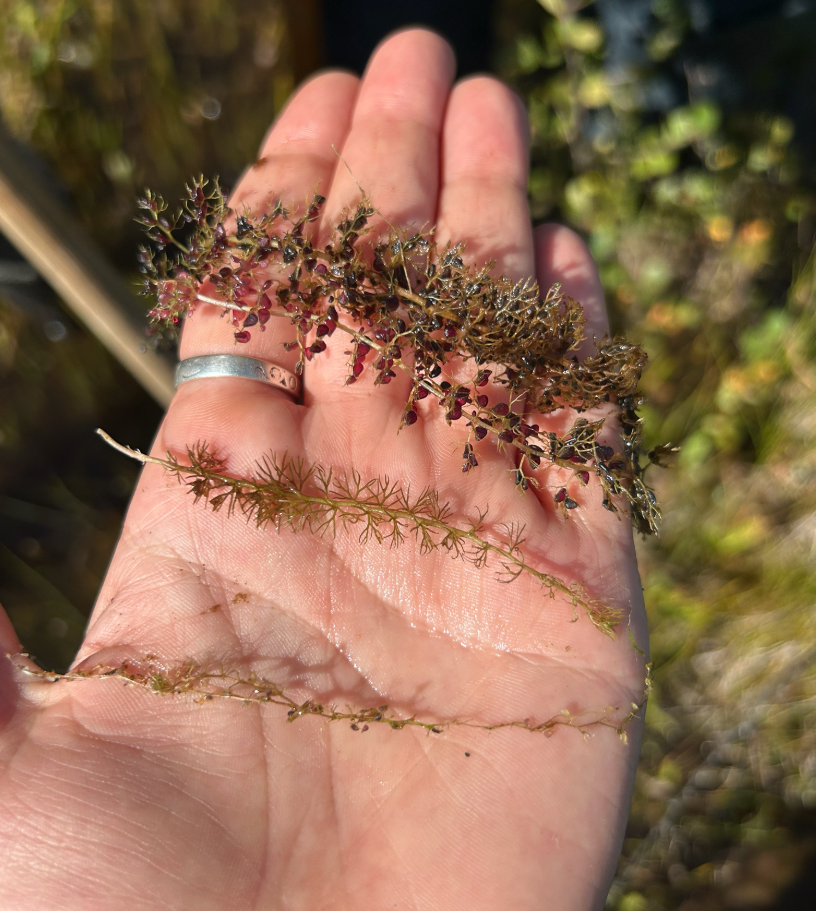
Selection of bladderworts.
Purple pitcher plant (Sarracenia purpurea) is a large carnivorous plant. Its basal leaves are modified into tube shaped pitchers, which gather rainwater. Prey items like insects or small spiders fall into the pitcher and drown, and are then digested by the plant. Common in fens of eastern Canada, the purple pitcher plant is at the western extent of its range in Alberta, and is more commonly found in fens of northeastern Alberta. Until this discovery near Edson, the furthest south record of purple pitcher plants in Alberta was at Clyde Fen. However this population is approximately 75 km south of Clyde Fen, and nearly 200 km west, making it the furthest south and west population in Alberta! This exciting find expanded purple pitcher plant’s range, and made me excited to try to find more populations!


Sarracenia purpurea.
The Sang Lake fen is a great find for exploring some of Alberta’s best fen plants. It’s close to Edmonton and road accessible (though the road will get pretty hairy after a rain!). Next year I hope to visit it multiple times throughout the summer to see what we missed this year. Hopefully I’ll see you out there!