
By Joelyn Kozar and Linda Kershaw, ANPC Botany Alberta Co-Chairs
March 2026
This year’s Botany Alberta brought plant lovers from across the province together in the Beaver Hills Biosphere from June 13–15, 2025, based out of the Strathcona Wilderness Centre.
Situated just east of Edmonton, the Beaver Hills region was designated a UNESCO Biosphere Reserve in 2016, recognizing its unique blend of natural beauty, biodiversity, and community stewardship. A product of the last glacial retreat, this knob-and-kettle moraine landscape supports rich wetlands, shallow lakes, mixedwood forests, and a remarkable diversity of plant and wildlife species. Its status as a biosphere reserve reflects a collective commitment to connecting people and nature, knowledge and action, and advancing conservation while supporting local communities across the region.
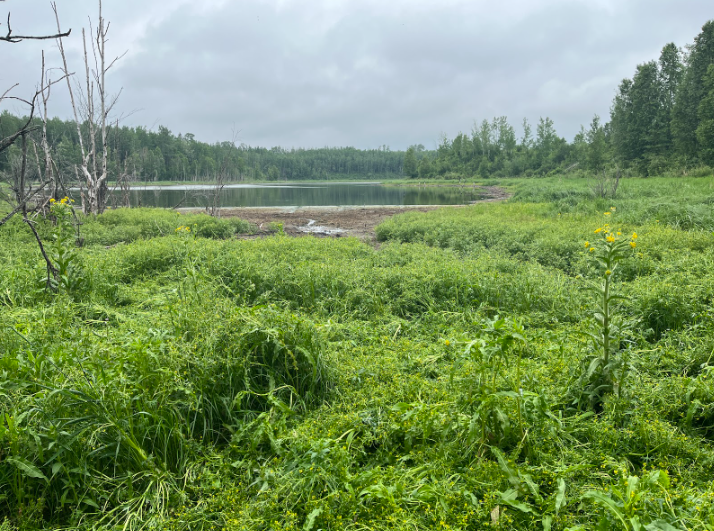
A tangle of Ranunculus sceleratus around a marsh in Smith Blackburn Homestead.
With this backdrop of global ecological significance, Botany Alberta 2025 set out to explore plant diversity, share knowledge, and celebrate the rich flora of this living landscape.
Friday, June 13 – Smith Blackburn Homestead & Potluck at the Lodge
Sixteen participants kicked off the weekend at the Smith Blackburn Homestead under dramatic skies. Although the forecast warned of thunderstorms, the weather held, and we were treated to calm, overcast conditions ideal for slow-paced fieldwork. A Great Grey Owl perched silently nearby as we gathered, lending a watchful presence to the afternoon. Representatives from the Edmonton Area Land Trust walked with us, offering insight into the history and stewardship of the property.
The wetlands were particularly striking: marsh-groundsel (Tephroseris palustris) lit up the sedge mats like yellow flames, celeryleaf buttercup (Ranunculus sceleratus) clustered near shallow pools, and we admired dense vegetation rings — a hallmark of healthy wetland systems. The group was engaged and observant, and conversations flowed between plant IDs, ecological restoration, and landscape history.
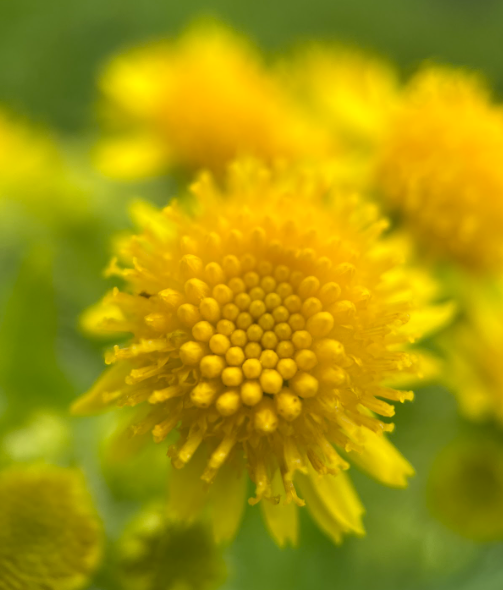
Tephroseris palustris flower.
That evening, we reconvened at the Strathcona Wilderness Centre for a cozy potluck supper, where guests staying at the Lodge brought hearty contributions including chili, cabbage salad, and berry desserts. As we ate, the long-anticipated thunderstorm finally arrived, offering us a dramatic light show from the comfort of the dining room windows.
Saturday, June 14 – Biodiversity Trail, Lodge Lunch & Evening Presentation
Despite steady drizzle, Saturday’s hike along the Beaver Hills Biodiversity Trail was a standout. The knob-and-kettle terrain revealed a patchwork of small wetlands and wooded ridges, each supporting distinct plant communities. Known to be botanically rich, the trail delivered once again with over 100 species of vascular plants. Greenflower wintergreen (Pyrola chlorantha) was found blooming along the trail. Participants commented on the sheer diversity within a relatively small area.
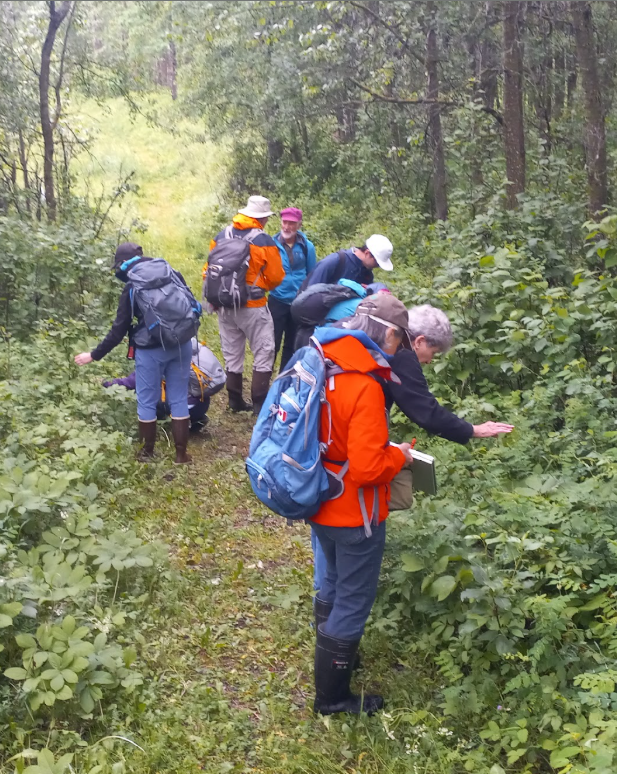
Botanizing on the Biodiversity Trail.
After a hot drink and lunch back at the Lodge, the group headed out again to explore the Strathcona Wilderness Centre’s trail network. A commonly referenced “bog” turned out to be a swamp, ecologically speaking — but the black spruce (Picea mariana), Common Labrador-tea (Rhododendron groenlandicum), and three species of Sphagnum gave it classic boreal character. Conversations turned toward wetland classification, peat development, and uncommon species, such as creeping snowberry (Gaultheria hispidula) and cloudberry (Rubus chamaemorus).
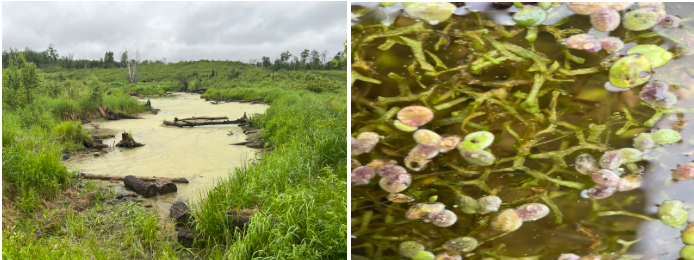
A marsh on the trail with floating aquatics Riccia fluitans, Spirodella polyrhiza, and Lemna turionifera.
Dinner, provided by A Cappella Catering, was nourishing and appreciated after a damp day in the field. The evening’s highlight was a presentation by Kevin Timoney, who provided a sweeping overview of the Beaver Hills Biosphere’s glacial past, ecological present, and climate future. He emphasized the critical role of Beavers (Castor canadensis) in maintaining water retention, landscape heterogeneity, and long-term habitat resilience — a theme that resonated strongly with the group. He also spoke about uncommon plant communities and species, including some we’d observed that day, such as the floating liverwort, purple-fringed riccia (Ricciocarpos natans), and the floating crystalwort (Riccia fluitans).
Earlier in the day, an exciting bryological discovery also emerged from Saturday’s explorations. Brittany and Erin documented and collected the thallose liverwort Riccia rhenana, a species not previously recorded in Alberta. R. rhenana is part of the Riccia fluitans complex and can be difficult to distinguish from the more familiar floating crystalwort (R. fluitans), which is known in the province. However, R. rhenana typically forms broader, more robust thallus branches that divide at wider angles and is generally larger overall, and it is not reddish in colour like R. fluitans. At a cellular level the species also differ: R. rhenana is polyploid (16 chromosomes) while R. fluitans is diploid (8 chromosomes). Both occur in slow-moving aquatic habitats, which can further complicate field identification. The specimen represents a new provincial record and highlights how much remains to be learned about the region’s bryophyte diversity.
Sunday, June 15 – Hicks Property & Nearby Conservation Sites
Sunday morning’s hike took us to the Hicks Property, where soggy trails and narrow pathways led us into wetland complexes less commonly visited. Participants enjoyed a slower pace and took more time to ask questions and document species. While not as high in numbers, the quality of discussion and field observation made for a strong close to the weekend. Some attendees continued on in the afternoon to explore the nearby Campbell and Ball-Berg conservation sites, further extending our botanical investigations.
Species List & Regional Records
This year, we took a hybrid approach to documenting biodiversity — combining iNaturalist observations from the event with data from recent reports to produce a more comprehensive species list for the Beaver Hills region. We will be sharing the results with our local conservation partners. Notably, the event resulted in the documentation of Riccia rhenana, representing a new provincial record for Alberta.
Cumulative Records (Botany Alberta 2025 + other sources):
- Vascular Plants: 277 species + 307 from other sources
- Bryophytes – Mosses: 36 species + 62 from other sources
- Bryophytes – Liverworts: 10 species + 12 from other sources
- Lichens: 22 species + 50 from other sources
Special thanks to Linda for showing us the beauty of her “backyard,” to Kevin for his insightful thoughts, to Brittany and Erin for their support with bryophyte ID, and to all our trail leaders and volunteers who helped make this possible.